
We Inspect USA Homes for a Living.
(These 7 “Smart Home Problems” Are’nt Tech Problems At All)
Smart thermostats failing. Locks disconnecting. Garage doors acting weird. The problem isn’t your tech—it’s your infrastructure.
Your Nest thermostat just stopped talking to your phone. Again. Your smart locks randomly disconnect at 3 AM. Your garage door opener opens itself while you’re at work. Welcome to the “smart” home nightmare nobody warned you about.
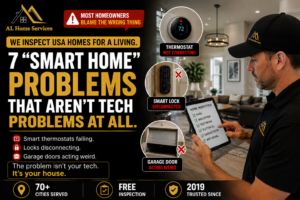
Here’s what’s actually happening: Most smart home problems aren’t tech issues—they’re infrastructure issues. That drafty attic killing your WiFi signal? The garage door springs making your opener work overtime? Your HVAC system struggling because of clogged ducts?
Those aren’t separate problems. They’re all connected.
The Thing Nobody Tells You About Smart Homes
I’ve installed hundreds of smart thermostats. Know what the #1 reason they “fail” is?
Bad insulation.
Sounds crazy, right? But here’s what happens: Your Nest learns your heating patterns. It sees your furnace running constantly but the temperature barely budging. So it thinks your furnace is broken and throws error codes.
But your furnace is fine. Your attic just has 30-year-old insulation that’s settled down to R-11 when it should be R-49.
💡 Real story from last week: A client in Pasadena spent $800 on three different smart thermostats thinking they were defective. Actual problem? Air ducts so clogged with construction dust that airflow sensors couldn’t get accurate readings. $280 duct cleaning fixed everything.
Your Smart Lock Isn’t Dumb—Your Door Is Warped
Got a Yale or August lock that keeps saying “door not secure” when it IS secure?
Check this: Does your door stick when you close it? Does it need a little push or pull to latch properly?
That’s your problem. Smart locks have tighter tolerances than traditional deadbolts. If your door frame shifted even 1/8 inch (super common in houses 10+ years old), the lock’s sensors think the door isn’t fully closed.
The fix everyone misses: It’s not the lock. You need your door frame adjusted or weatherstripping replaced. Takes 20 minutes, costs $50-100.
We’ve seen people return four different “broken” smart locks when their door just needed a simple locksmith adjustment.
Why Your Smart Garage Door Opener Ghosts You
The 3 Hidden Garage Door Issues That Kill Smart Openers:
- Worn springs create inconsistent resistance. Your opener’s motor thinks something’s blocking the door, so it stops mid-cycle. Fix: Replace the springs, don’t replace the opener.
- Dirty sensors trigger false “obstruction” errors. That little photo-eye near the floor? If it’s dusty, your app shows “door won’t close” but the door is fine. Fix: Wipe sensors with a microfiber cloth monthly.
- WiFi extenders create connection loops. Your garage door connects to your extender, which routes through your main router, which causes 3-second delays. That delay makes the app think the door didn’t respond. Fix: Add a dedicated 2.4GHz network just for garage devices.
The Air Quality Sensor Rabbit Hole
Smart air quality monitors (Awair, Air Things, etc.) are awesome—until they start showing “poor air quality” 24/7 even though everything smells fine.
Here’s what’s actually going on:
These sensors measure VOCs (volatile organic compounds) and particulates. Know what produces both? Dirty air ducts recirculating dust and mold spores.
You can’t fix bad IAQ (indoor air quality) with a $300 sensor. You need to fix the source.
Quick test: Check your air filter. If it’s brown/black after 30 days (should last 90), you’ve got a duct problem. That dust is coming from somewhere. Our air duct inspection finds the source—usually construction debris, pest nests, or failed duct seals.
Smart Thermostat “Short Cycling”—The $3,000 Mistake
Your Ecobee keeps turning your AC on for 5 minutes, then off for 5 minutes, then on again. That’s called short cycling, and HVAC companies will immediately try to sell you a new compressor ($3,000-5,000).
Stop. Before you spend a penny, check these three things:
- Dirty air filter (60% of short cycling issues)
- Blocked return vents (furniture, rugs, or closed vents in unused rooms)
- Thermostat location (if it’s near a heat source like a TV or in direct sunlight, it gets false temp readings)
We literally saved a client $4,200 last month. His “dying AC compressor” was fine—his dryer vent was venting hot air right under his thermostat sensor. Relocated the vent exit, problem solved.
The WiFi Dead Zone in Your Garage (And Why It Matters)
Ever notice your garage door opener takes 10-15 seconds to respond to your phone, but lights and locks work instantly?
Insulation blocks WiFi signals.
If you’ve got good attic insulation (which you should), it’s probably blocking 40-60% of your router’s signal from reaching the garage. Your router is usually in the living room or upstairs—completely opposite side of the house from your garage.
The fix? Don’t buy a WiFi mesh system. That’s overkill. Just add one dedicated access point in your laundry room or kitchen (whichever is closest to the garage). Costs $30-50 vs. $300+ for a full mesh setup.
When “Smart” Actually Makes Things Dumber
Real talk: Some things don’t need to be smart.
Smart smoke detectors? Great idea. They alert your phone when you’re not home.
Smart ceiling fans? Pointless. The wall switch already does that job, and now you’ve added a $200 part that fails in 5 years.
Smart door locks? Worth it IF your door and frame are in good condition (see above). If you’re fighting with your key every day, a smart lock won’t help.
Smart Home Priorities That Actually Make Sense:
| Priority 1 | Fix foundation problems first. If your HVAC, doors, or garage door aren’t working right mechanically, smart tech won’t help. |
| Priority 2 | Upgrade insulation and air sealing. This makes smart thermostats actually effective. |
| Priority 3 | Clean your ducts and vents. Air quality sensors are useless if you’re just monitoring dirty air. |
| Priority 4 | THEN add smart devices. They’ll actually work correctly now. |
The One Smart Device Everyone Should Have (But Nobody Buys)
Forget video doorbells and robot vacuums. The smartest smart device you can buy?
A water leak detector.
$40 sensor that sits under your water heater, washing machine, or dishwasher. When water touches it, it screams and sends your phone an alert.
Why? Because a washing machine supply line failure dumps 300-500 gallons before you notice. That’s $8,000-15,000 in water damage and remediation.
We’ve seen three of these save homes in the past year. One was on vacation in Mexico when his water heater burst—leak sensor alerted him, he called a neighbor, neighbor shut off the main valve. Total damage: $0.
Get Your Home Actually Smart-Ready
Before you spend another dollar on “smart” gadgets…
Let’s make sure your home’s foundation systems actually work. We at AL Home Services fix the boring stuff that makes the cool stuff work right.
Related: Attic insulation upgrades • Air duct inspection • Garage door repair • All home services